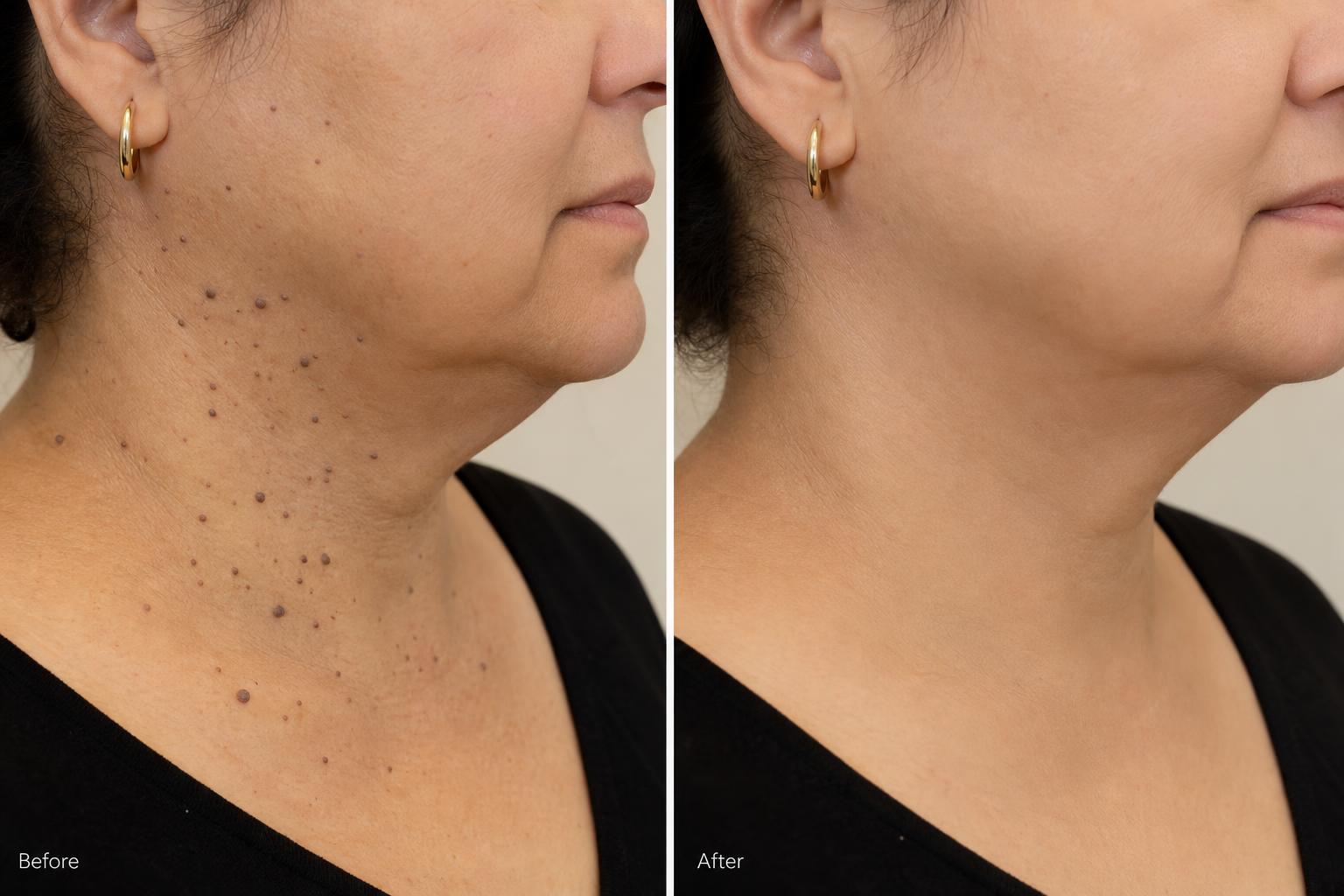
There is a category of skin concerns that almost everyone has, almost nobody talks about, and almost nobody realizes can be corrected quickly, safely, and permanently without surgery, lasers, or a dermatology referral.
Skin tags on the neck. Milia under the eyes. Cherry angiomas on the chest. Broken capillaries on the cheeks. Sebaceous hyperplasia on the forehead. These are among the most common concerns I see in the studio — and among the most undertreated, simply because most people do not know a solution exists outside of a surgical office.
Skin Classic is that solution. Here is what you need to know.
What Is Skin Classic?
Skin Classic is an award-winning high-frequency technology that delivers direct electrical current through a fine-tip probe to the surface of a targeted skin irregularity. The current precisely dehydrates the lesion — causing it to form a small natural crust that heals and flakes off within 3 to 15 days, revealing clear skin underneath.
It works on the epidermis only. It treats the irregularity and leaves every millimeter of surrounding skin completely untouched. Each individual lesion takes seconds. Multiple irregularities can be addressed in a single session. There are no lasers, no scalpels, no stitches, and no surgery referral required.
Skin Tags — Why They Form and Why They Stay
Skin tags are small, soft, benign growths — technically called acrochordons — that develop where skin experiences friction or hormonal influence. The neck, underarms, eyelids, chest, and groin are the most common locations. They are entirely benign and pose no health risk. They also will not go away on their own.
Once a skin tag forms, it has its own blood supply and cellular structure. Without intervention — whether freezing, cutting, or high-frequency treatment — it remains indefinitely and often grows larger over time. Skin Classic dehydrates the lesion at the surface in seconds, cutting off the cellular activity that sustains it. The treated tag crusts, heals, and falls away within 3 to 15 days. It does not return.
Milia — The Ones You Cannot Squeeze
Milia are tiny, hard white cysts that form just below the skin surface when keratin — a skin protein — becomes trapped in the pore. They look like small white bumps and are most common around the eyes, on the cheeks, and across the nose. They are often confused with whiteheads, but they are not extractable in the way a whitehead is. Squeezing milia does nothing because they sit below the skin's surface in a closed sac.
Topical products rarely resolve milia because they cannot penetrate the keratin sac. Skin Classic dehydrates the cyst precisely and safely — without cutting the skin, without damaging surrounding tissue, and without the risk of scarring that comes from aggressive manual extraction attempts. For clients who have had milia under their eyes for years, Skin Classic is often their first effective solution.
Cherry Angiomas — The Red Spots That Multiply With Age
Cherry angiomas are small red or bright-pink vascular lesions — collections of dilated capillaries just below the skin surface. They are entirely benign and very common, particularly in clients over 30. They tend to multiply with age and do not resolve on their own. Most clients notice them appearing first on the chest and torso, then increasingly on the face and arms over time.
Skin Classic collapses the tiny blood vessels that form the angioma instantly. The lesion turns grey or white during treatment — a sign that the vascular activity has ceased — and heals cleanly within a week. Results are immediate and permanent for the treated lesion.
Broken Capillaries and Telangiectasia
Broken capillaries — also called telangiectasia or spider veins on the face — are tiny red or purple blood vessels visible just below the skin surface. They are most common around the nose, cheeks, and chin, and are often associated with rosacea, sun exposure, alcohol consumption, or simply genetics.
Skin Classic collapses the capillary wall directly, making it disappear from the surface. For clients with rosacea who have visible diffuse redness, Skin Classic addresses individual visible capillaries while other modalities — including Dr. Platon cold plasma — address the underlying inflammation.
Sebaceous Hyperplasia — Enlarged Oil Glands
Sebaceous hyperplasia appears as raised, yellowish-white or flesh-colored bumps — enlarged oil glands that have grown beyond their normal size. They are very common in mature skin, particularly in clients with a history of oilier complexions, and are frequently mistaken for milia or closed comedones. Standard extraction does not resolve them because the issue is the gland itself, not the contents.
Skin Classic targets and dehydrates the enlarged gland directly, collapsing its structure. The treated area heals within 1 to 2 weeks, leaving smooth skin in place of the bumps.
Flat Hyperpigmentation and Age Spots
Flat dark spots — caused by UV exposure, hormonal changes, or post-inflammatory pigmentation — respond to Skin Classic differently than vascular or structural irregularities. The high-frequency current brings the pigment to the surface and accelerates its natural shedding process. The treated spot forms a small dark crust that flakes away within 5 to 7 days, revealing more even-toned skin beneath.
For clients who have tried brightening serums, vitamin C, and professional peels with limited success on stubborn individual spots, Skin Classic often produces the result those treatments could not. It works on the pigment directly rather than trying to suppress melanin production over time.
What a Skin Classic Session Looks Like
Sessions at Amata Lucè™ begin with a thorough review of all irregularities. Gloria will assess each lesion to confirm it is appropriate for Skin Classic treatment. Any lesion that appears unusual or potentially concerning is referred for physician evaluation before treatment proceeds — this is a non-negotiable part of the protocol.
The skin is thoroughly cleansed. The Skin Classic probe is held just above — barely touching — the surface of each targeted irregularity. A brief precise burst of current is delivered. Each lesion takes only a few seconds. Most clients describe the sensation as a brief snap or pinch lasting a fraction of a second. Because individual treatments are so fast, even sessions addressing many lesions are well-tolerated without numbing.
After treatment, small crusts form over each treated area. These are the healing response — not wounds. They flake off on their own within 3 to 15 days. Do not pick them. Gentle moisturizer and physical SPF daily during healing is all that is required.
Pricing
15-Minute Session — $125. For 1 to 5 lesions in a single area.
30-Minute Session — $200. Multiple irregularities in a single visit.
60-Minute Full Clearance Session — $325. Comprehensive treatment across the full face, neck, or chest.
Dermafrac Microdermabrasion Prep Add-On — $100. Recommended before Skin Classic for optimal results.
How Skin Classic Fits Into The Lucè Approach™
At Amata Lucè™, Skin Classic addresses the surface irregularities that distract from the skin quality work happening at a deeper level. Many clients combine Skin Classic with Perfect Derma Peel for diffuse pigmentation, Purasomes microneedling for collagen restoration, or Dermafrac microdermabrasion for ongoing surface maintenance. The treatments are designed to work together — each one addressing a different layer of the skin's function and appearance.
A Clinical Note from Gloria
One of the things I love most about Skin Classic is how immediate and tangible the results are. Clients come in with a skin tag they have had for ten years — something they have simply accepted as permanent — and it is gone before they leave the treatment room. The crust heals in a week. The skin is clear. The spot does not return.
There is something deeply satisfying about that. Not every result requires months to see. Some things just need the right tool applied precisely — and Skin Classic is that tool for this category of concerns.
— Gloria Dawit-Puri, RN + Master Esthetician, Founder Amata Lucè™
This article is written for educational purposes and does not constitute medical advice. Consult a licensed healthcare provider for diagnosis and treatment. Sources available below.
References
On Skin Tags (Acrochordons) — Formation, Structure, Prevalence
- "Skin Tag (Acrochordon)." StatPearls. National Library of Medicine. Updated December 2025. ncbi.nlm.nih.gov
- Banik R, Lubach D. "Skin Tags: Localization and Frequencies According to Sex and Age." PubMed. pubmed.ncbi.nlm.nih.gov
- "Acrochordon." Medscape/eMedicine. emedicine.medscape.com
- "Skin Tags (Acrochordons)." Cleveland Clinic. my.clevelandclinic.org
On Milia — Keratin Cyst Formation, Location, Why Squeezing Fails
- "Milia." StatPearls. National Library of Medicine. ncbi.nlm.nih.gov
- Berk DR, Bayliss SJ. "Milia: A Review and Classification." Journal of the American Academy of Dermatology. 2008;59(6):1050–1063. (Referenced via DermNet NZ) dermnetnz.org
- "Milia: Practice Essentials, Epidemiology." Medscape/eMedicine. emedicine.medscape.com
- "Cutaneous Cysts." MSD Manual Professional Edition. msdmanuals.com
On Cherry Angiomas — Dilated Capillaries, Age-Related Prevalence, Benign Nature
- "Cherry Hemangioma." StatPearls. National Library of Medicine. ncbi.nlm.nih.gov
- "Cherry Hemangioma: Practice Essentials, Pathophysiology, Etiology." Medscape/eMedicine. emedicine.medscape.com
- "Cherry Angiomas." MSD Manual Professional Edition. msdmanuals.com
- Buslach N, Foulad DP, Saedi N, Mesinkovska NA. "Treatment Modalities for Cherry Angiomas: A Systematic Review." Dermatologic Surgery. 2020;46(12):1691–1697. (Referenced in MSD Manual above)
On Telangiectasia / Broken Capillaries — Causes, Rosacea Association, Treatment
- "Telangiectasia." Hospital for Special Surgery (HSS) Health Library. hss.edu
- Li T, et al. "Improved Telangiectasia and Reduced Recurrence Rate of Rosacea After Treatment with 540 nm-Wavelength Intense Pulsed Light: A Prospective Randomized Controlled Trial with a 2-Year Follow-Up." PMC. 2020. pmc.ncbi.nlm.nih.gov
On Sebaceous Hyperplasia — Enlarged Oil Glands, Androgen Influence, Age
- "Sebaceous Hyperplasia." StatPearls. National Library of Medicine. ncbi.nlm.nih.gov
- "Sebaceous Hyperplasia: Background, Pathophysiology, Etiology." Medscape/eMedicine. emedicine.medscape.com
- Serdar ZA, et al. "Treatment of Sebaceous Hyperplasia by High-Frequency Focused Ultrasound (HIFU): A Comprehensive Exploration with Clinical Insights." PMC. 2025. ncbi.nlm.nih.gov
On High-Frequency / Electrosurgery as a Treatment Modality
- Simmons BJ, et al. "Light and Laser Therapies for the Treatment of Sebaceous Gland Hyperplasia: A Review of the Literature." Journal of the European Academy of Dermatology and Venereology. 2015;29(11):2080–2087. (Referenced in Medscape Sebaceous Hyperplasia Treatment above)
- "Telangiectasia Treatments Including Electrosurgery." Spot Check Clinic. spotcheck.clinic (For clinical context on electrical current collapsing capillary walls)