
By Gloria Dawit-Puri
For Mebrahtu Dawit. October 2, 1927 — May 12, 2021. Emba Derho, Eritrea.
And for Tahirih Mebrahtu Dawit. September 21, 1978, Asmara, Eritrea — April 19, 2000, St. Paul, Minnesota. Always.
And for Maza Habtu. Born in Asmara — laid to rest in July 1990 at Lakewood Cemetery. Auntie. The one who opened the door.
The Alphabet
In a neighborhood called Geza Kenisha, in Asmara, Eritrea, a boy who had never been to school found a neighbor who showed him the English alphabet.
He was sixteen. He had been working as a laborer since he was six years old. He had no father — he lost him so young that not even a memory remained. No image. No voice. Nothing to return to. Just the fact of the absence, and everything that absence required him to become on his own.
His father's name was Dawit Teklu. He was not a laborer. He was a farmer — and the son of a man named Teklu Okbai, who served as a surgeon's assistant to a Swedish surgeon in Eritrea. A man of roots, of land, of a lineage that carried its own dignity. Mebrahtu never got to know him. But knowing who Dawit Teklu was matters. The absence was not of an ordinary man. It was of a man who came from something — and whose son would spend a lifetime building something in his place, without ever having had the chance to learn from him how it was done.
The life of Teklu Okbai — my great-grandfather — is documented in a book called Kenisha: The Roots and Development of the Evangelical Church of Eritrea, 1866–1935, by Karl Johan Lundstrom and Ezra Gebremedhin. I did not know this book existed until after my father passed away. Someone told me about it. I found it on Amazon and I purchased it.
When it arrived, I opened it — and there he was. A photograph of Teklu Okbai. And alongside it, a photograph of my late grandfather Dawit Teklu, taken a very long time ago, when he was still a young boy.
I was not prepared for what I saw.
In the face of my great-grandfather Teklu — across all that distance, all those decades, all that history — I could see my grandfather. Dawit Teklu. The father my father never had a memory of. The man whose absence had shaped everything. There he was, in the face of his own father, in a photograph taken long before any of us existed.
It was a family portrait. Teklu Okbai and his young family — all of them together, captured in a moment none of us knew existed. For the first time in my life, I could see my grandfather. Not a description of him, not a story about him — his face. And around him, the family he came from. The people my father never got to know. The roots that had always been there, waiting to be found.
My father never knew his father. He never knew his grandfather's face. He did not have the photographs. He did not have the stories.
But the face was his all along. It had always been his.
I found that out after he was gone. And I am still understanding what it means — that he carried something in him he never got to see. That the man who built everything from nothing was, in fact, building on something. A lineage of people who showed up, who served, who made themselves useful and indispensable in whatever world they found themselves in.
That is not nothing. That was never nothing.
He took what the neighbor gave him and he taught himself to read.
Everything that follows — including this practice, including this magazine, including the name Belle Vie — begins there. In Geza Kenisha. With a neighbor. With an alphabet. With a boy who decided that what he had been given was enough to start.
His name was Mebrahtu Dawit.
He was born on October 2, 1927, in Emba Derho — a small highland town a few miles outside Asmara, in the highlands of Eritrea. He was my father. And I want to tell you about him — not because I am trying to market something, but because I do not think I can honestly explain what I have built without explaining where it came from.
I want you to understand what it meant to grow up in Asmara in those years.
Eritrea sits at one of the great crossroads of the world — the Horn of Africa, where the Red Sea meets ancient trade routes, where the Arab world and the African continent have always pressed against each other. The city my father grew up in was a place of layered languages and layered histories. There were nine ethnic groups in Eritrea, each with their own tongue. There were Yemeni traders and Sudanese neighbors and Italian colonial administrators and British military officials and Eritreans from a dozen different communities all moving through the same streets.
My father absorbed all of it.
He was six years old when he began working as a laborer. Six. The age when most children in other parts of the world are just beginning to learn their letters, my father was already carrying loads, already contributing, already learning the first lesson his life would teach him — that you work with what is in front of you. You do not wait for better conditions. You begin.
The neighborhood of Geza Kenisha was a place where languages lived side by side. You heard Tigrinya and Arabic and Italian and Amharic and the languages of Yemen and Sudan all in the same street, the same market, the same ordinary Tuesday afternoon. My father listened. He always listened. That was the thing about him — he understood, even as a child, that the world was speaking and that the ones who paid attention were the ones who would be able to move through it.
And then the neighbor showed him the alphabet.
At sixteen. After ten years of laboring. With no father, no formal schooling, no institutional support of any kind.
He took that alphabet and he built a life.
The first thing he did with literacy was keep going.
He taught himself to read — and then he read. He learned — and then he looked for the next thing to learn. That was who he was. Not restless exactly. Something more intentional than restlessness. He was fiercely committed to whatever he took on, completely and without reservation. When Mebrahtu Dawit decided something was worth doing, he did not do it halfway. He did not test the waters. He did not hedge. He was all in — in a way that I have rarely seen in another human being and that I have spent my whole life trying to understand and emulate.
That quality — that absolute, unambiguous loyalty to the things and people he believed in — is what connects every chapter of his life. It is what made him the man he was.
He was hired by the British government, which administered Eritrea after World War II, as a public health worker. A farmer's son. A man who had taught himself to read from a neighbor's kindness. Working for the British government because what he had built in himself could not be ignored.
Then he decided he wanted to learn to type.
So he took a course. He became good at it. And the next door opened.
Then he was hired by Point 4.
Most people have never heard of Point 4.
Point 4 was announced by President Harry S. Truman in his inaugural address on January 20, 1949. It was the first global United States foreign aid program — not financial aid, but technical assistance. American know-how shared with the developing world in agriculture, public health, industry, and infrastructure. It was, in part, a response to the Cold War — a demonstration that democracy and development could improve human lives. The program eventually became what we now know as USAID.
My father was hired by that program. In Eritrea. Because what he had built in himself was undeniable.
They valued him enough to pay for his driving lessons so he could serve as both a clerk and a driver. He learned everything the program had to teach him. He contributed to an initiative that the President of the United States had called one of the most important foreign policy objectives of the postwar era.
But Point 4 matters for another reason too.
Among the programs it established in Eritrea was a four-year nursing training program.
My father knew about it. And he knew someone who should apply.
His first cousin — her name was Teberh Abraha — was a young woman who my father believed had something in her worth developing. He encouraged her to apply to the nursing program. When she felt like dropping out, he encouraged her to stay. When the path got hard, he was the voice that said — keep going.
She kept going.
Teberh Abraha became a Registered Nurse. She worked in labor and delivery for over fifty years.
She is the aunt I lived with in Los Angeles, California — for a year and a half.
A year and a half inside the home of a woman who had spent fifty years bringing new life into the world. Who had stayed in nursing school because my father told her to keep going. Who had built an entire career — an entire identity — from the encouragement of a man in Asmara who believed in her before she fully believed in herself.
I watched her. I lived in her world. I saw what it meant to care for people with that kind of steadiness and dedication — not occasionally, but as the daily practice of a life.
She is the reason I became a Registered Nurse.
My father encouraged her to become one.
I did not understand the full circle of that until I was already inside it.
A boy in Geza Kenisha finds an alphabet from a neighbor. He teaches himself to read. He works his way from laborer to public health worker to typist. He is hired by Point 4. That program creates a nursing school in Eritrea. He encourages his cousin to enroll. He talks her out of quitting. She becomes a nurse for fifty years. She welcomes her niece into her home in Los Angeles for a year and a half. That niece becomes a nurse. That nurse becomes a Master Esthetician. That esthetician builds a clinical practice in Burke, Virginia and names the magazine she writes for her father's memory — in French, because he taught himself six languages and she wanted to honor every one of them.
All of it. From one neighbor. From one alphabet. From Geza Kenisha.
The Languages
The languages are not a footnote. They are the whole story told a different way.
My father grew up surrounded by the languages of the world pressing in from every direction. Tigrinya was his mother tongue — the language of the Eritrean highlands, his first and deepest self. But Asmara was not a city where one language was enough. The Yemeni traders spoke Arabic. The Italian colonizers had left their language embedded in the architecture and the café culture and the street names. The British administrators brought English. The Ethiopian annexation brought Amharic. The nine ethnic groups of Eritrea brought nine distinct tongues.
He absorbed what surrounded him the way he absorbed everything — completely, and without wasting a moment.
But he did not stop at absorption. He went further.
As an adult — already working, already building a life, already navigating a career — he sat in night classes to learn French. And Arabic formally. On top of everything else. On top of the work and the family and the moving and the starting over.
Six languages in total. Tigrinya. Amharic. Italian. English. Arabic. French.
Six doors. Six lives he could walk into that most people never could. Six ways of saying — I see you, I can meet you where you are, you do not have to translate yourself for me.
I think about that when I look at this website and count the twenty-two languages it speaks. I did not plan that as a tribute. It simply felt wrong to do anything less. He showed me that language is how you tell someone they belong. That it is one of the most fundamental acts of respect one human being can offer another.
The Airlines
After Point 4, he worked for a travel agency.
Even then — as a young man in Asmara, building a career step by step — he tried to go further. He applied for scholarships. He wanted formal higher education. He was turned down.
Not because of his mind. Because of paperwork. Because of the high school diploma he had never had the chance to earn — the one that a six-year-old laborer in Eritrea, living under colonial occupation with no father and no institutional support, could not have been expected to produce. The world that had taken his childhood had also taken his eligibility.
He did not stop. He bought correspondence courses. He studied at home — the way he had always studied, the way he had always learned, the way he had been doing since a neighbor in Geza Kenisha showed him the first letters of an alphabet he had no business knowing. Alone. Deliberately. Without waiting for the world to make a place for him.
When the institution said no, he found the book. When the scholarship closed its door, he opened his own.
And then in the early 1960s he joined Ethiopian Airlines at the Asmara head office as a sales representative.
He stayed for twenty-one years.
Twenty-one years. That is not a job. That is a commitment.
In 1975, while still at Ethiopian Airlines, he became a Bahá'í in Asmara. And that same year, on December 5, 1975, he married my mother.
It was a difficult time to be alive in Asmara. The civil war was not distant — it was present, pressing, immediate. My mother has said that they married knowing they might not live long. That the world around them offered no guarantees and no promises about tomorrow. They married anyway. Fully. Without reservation. In the way that Mebrahtu Dawit did everything.
That is not recklessness. That is faith. That is two people deciding that love and commitment are worth honoring even when — especially when — the future is uncertain.
I was born premature in August of 1976. My late sister Tahirih arrived on September 21, 1978.
He retired in 1982. Then he found a position in Kaduna, Nigeria. The whole family went. He worked there for about three years. And then we all came back to Asmara together.
I want to tell you about the year he taught us at home.
He had not planned for us to stay long in Asmara when we returned from Nigeria. But he could not find work outside the country. And my sister Tahirih and I — we could not go to school. The local schools taught in Italian or Amharic. I had forgotten most of my Italian by then. The schools wanted to put me back two grades.
My father refused.
He went to the British Library in Asmara and borrowed books. He sat with us at home — my sister and me — and he taught us himself. All subjects. Every day. For over a year.
A man who had taught himself to read at sixteen, now teaching his daughters from borrowed library books in a downtown apartment because the world had not made space for us yet and he was not going to wait for it.
He also hired tutors who could teach us Amharic so that eventually we could rejoin the local schools. And we did. I entered in the 5th grade. My sister Tahirih entered in the 3rd grade.
That year she was third in her class.
I was eleventh in mine.
The school was not close to our apartment. It was near Medeber — a long walk from downtown Asmara.
My father walked us there every morning. And every afternoon he came to pick us up.
Before we left home, or when we arrived at the school gates, we would stand together in a corner and say our prayers. He always made time for that. The quiet moment before the day began, where we stood together and asked for what we needed.
On weekends he took us to the movie theaters. He took us for gelato — in a cone. We would walk through the city together, my father and my sister and I, doing what Italians call a passeggiata — an evening stroll through the streets just to be in the world. Talking. Enjoying the atmosphere. Friends would stop us on the way and my father would stop and talk, unhurried, present, as though there was nowhere else he needed to be.
On Sunday mornings he woke us early for prayers. But first — before the Baha'i Center, before the prayers — he took us to the local café. Pastry. Cappuccino for my sister and me. We were dressed in our Sunday best. Two little girls in their finest, sitting in an Asmara café with their father before the morning service, being treated as though the day was something worth celebrating before it had even properly begun.
He always spoke to us with kindness. He always answered our questions. Every single one. With patience and without making us feel like our curiosity was too much or our concerns too small.
We always felt heard. We always felt respected.
I have thought about those words many times since I built this practice. Heard. Respected. They sound simple. They are not. Most people go through their whole lives — in doctor's offices, in treatment rooms, in the chairs of people who are supposed to help them — feeling like something less than that.
My father gave us that as a daily practice. Not occasionally. Every day. On the walk to school. In the corner before we went in. At the dinner table when we had questions.
I learned what it means to take someone seriously from a man who took his daughters seriously when the world had given him every reason to be preoccupied with his own survival.
Liberia
In 1987, he moved to Monrovia, Liberia.
The whole family went again. That was who he was — not a man who went ahead and sent for people later, but a man who brought his family with him. Who understood that wherever he was going, he was not going alone.
He was in Liberia from 1987 to 1990.
In December 1988, the trouble was still far from Monrovia. Most people in the capital were not yet worried. My father was. He was extremely analytical — he read into things, always had — and he read the tension that was building in the countryside and it concerned him. What he saw coming would become Charles Taylor's rebellion and the First Liberian Civil War, one of the most brutal conflicts in West African history.
He had learned to read a country the hard way. As a child laborer in Asmara he had lived through the fighting between the British and the Italians in the Second World War. He had lived through the Ethiopian revolution that deposed Emperor Haile Selassie, and through the years of Mengistu Haile Mariam that followed. He was in his early sixties. He knew what the beginning of something looked like.
Before the war reached the capital, he made a decision.
On January 28, 1989, he put my mother, my sister Tahirih, and me on a plane out of Monrovia, Liberia — to Los Angeles, to my aunt Teberh Abraha. The same woman he had once talked out of quitting nursing school. The same woman whose entire fifty-year career in labor and delivery existed because he had believed in her before she believed in herself. When the most dangerous moment of our lives arrived, he sent us to the one person he trusted most completely.
Then he stayed behind.
He lived through part of the coup. When he finally left, he was on the last plane out of Liberia.
I do not know the date. We did not have regular calls in those months, and he was not a man who relived things. What he had seen in Liberia stayed in Liberia. He did not carry it into every room for the rest of his life the way many people would have. He set it down and looked at what was in front of him.
He spent his entire life opening doors for the people he loved — and when the most dangerous door appeared, he made sure his wife and daughters walked through it first. Then he stood at the threshold alone and waited for his own way out.
The circle of it — that the woman he had saved became the woman who received us, who sheltered us, in whose home I would spend a year and a half watching what a life of devoted care looks like — is not something I can explain as coincidence. It is what happens when a person spends sixty years being faithful. The faithfulness comes back. At exactly the right moment.
Minnesota
On June 30, 1990, my mother, my sister Tahirih, and I landed in Minnesota.
Our late aunt, Maza Habtu, received us in her home. She was there. She opened the door.
She had advanced breast cancer.
One week after our arrival, she was gone.
We had come to be received. We stayed to grieve. In a country we did not yet know, in a city that was not yet home, while our father was still making his way out of Liberia. We were two young women standing in the middle of a loss we had not anticipated, in a place that did not yet have the shape of belonging.
And then the Eritrean community in Minnesota found us.
They came with food and drink. They sat with us. They mourned with us — not briefly, not politely, not with the careful distance that so much of modern grief expects. They stayed. They spent the nights with us. They did not leave our side for approximately two months.
Two months.
In the ancient traditions of East Africa, mourning is not a private matter. Grief is not something you manage quietly behind a closed door. It is something the community holds together — with presence, with food, with the willingness to stay through the nights so that the bereaved are never alone in the dark hours when loss feels most absolute. The Eritrean community in Minnesota carried that tradition with them across an ocean and into a city that did not always understand it. And they gave it to us completely.
We were not alone. Because of them.
After those months of mourning, we moved. From Minneapolis to St. Paul — a city that would become home in the fullest sense of the word.
Soon after moving to St. Paul, a friend from Minneapolis introduced us to the Bahá'í community in St. Paul.
We did not have much. That is the honest way to say it. We were new to a country, without resources, still finding our footing in a place that did not yet feel entirely like ours. The Bahá'í community received us the way the best communities do — not with pity, but with presence. They offered my sister and me occasional babysitting jobs when we needed the income. They gave us rides to Bahá'í school on Sundays and to the Feasts. Small things, in the accounting of the world. Not small to us. To two young women who were learning what it meant to belong somewhere, those rides and those evenings and that welcome meant everything.
You find out who people are in the seasons when you have nothing to offer in return. The Bahá'í community of St. Paul showed us exactly who they were.
My father had spent his entire life showing up for people — encouraging his cousin to stay in nursing school, walking his daughters to school in Asmara, staying behind in a war zone so his children could be safe. The community that received us in Minnesota was made of people who had learned the same lesson from their own lives. You show up. You do not leave. You do not let the people you love stand alone in the hardest moments.
He got out of Liberia. And when he landed in Abidjan, Ivory Coast, he did not stop. He did not collapse into what had happened. He looked around at where he was and he asked — what can I learn? What can I offer? What is the next door?
The answer was French.
He had taken those night classes years before. He had sat in a room after long days of work and learned a language he did not yet need because he understood, somewhere deep in himself, that the prepared person is the one who moves through the world with options.
In Ivory Coast, that preparation became a career.
He was hired as a sales representative for a charter airline in Abidjan — because he could speak French. Because he could write in French. Because a man who had begun as a child laborer in Eritrea had, over the course of a lifetime, made himself indispensable in a West African city to a European-operated airline.
That is the night class paying off thirty years later.
He moved to the United States in October 1992.
He was sixty-five years old.
Sixty-five. The age when most Americans are planning retirement. The age when most people believe the major chapters of a life have already been written. He crossed an ocean and arrived in St. Paul, Minnesota — one of the coldest cities in America, home to one of the most remarkable East African diaspora communities in the country — and he began again. He did not talk about Liberia. He talked about pleasant things, about what he believed in, about his faith — not about what had caused him pain. He was all about Minnesota now — about what he could do, here, to support his family.
He had represented Ethiopian Airlines for twenty-one years. He had navigated Point 4 and British colonial administration and a charter airline in Ivory Coast. He spoke six languages. He had survived a civil war.
And he got a job as a busboy.
Then a parking lot attendant.
He did those jobs the way he did every job — without complaint, without the bitterness that would have been so understandable and so human. Because that is not who he was. He was not a man who measured the distance between where he had been and where he now stood and called it humiliation. He was a man who showed up. Who worked. Who understood that dignity is not something the work takes from you — it is something you bring to the work.
Then he became a janitor at the College of St. Catherine in St. Paul.
This was not a concession. This was a decision.
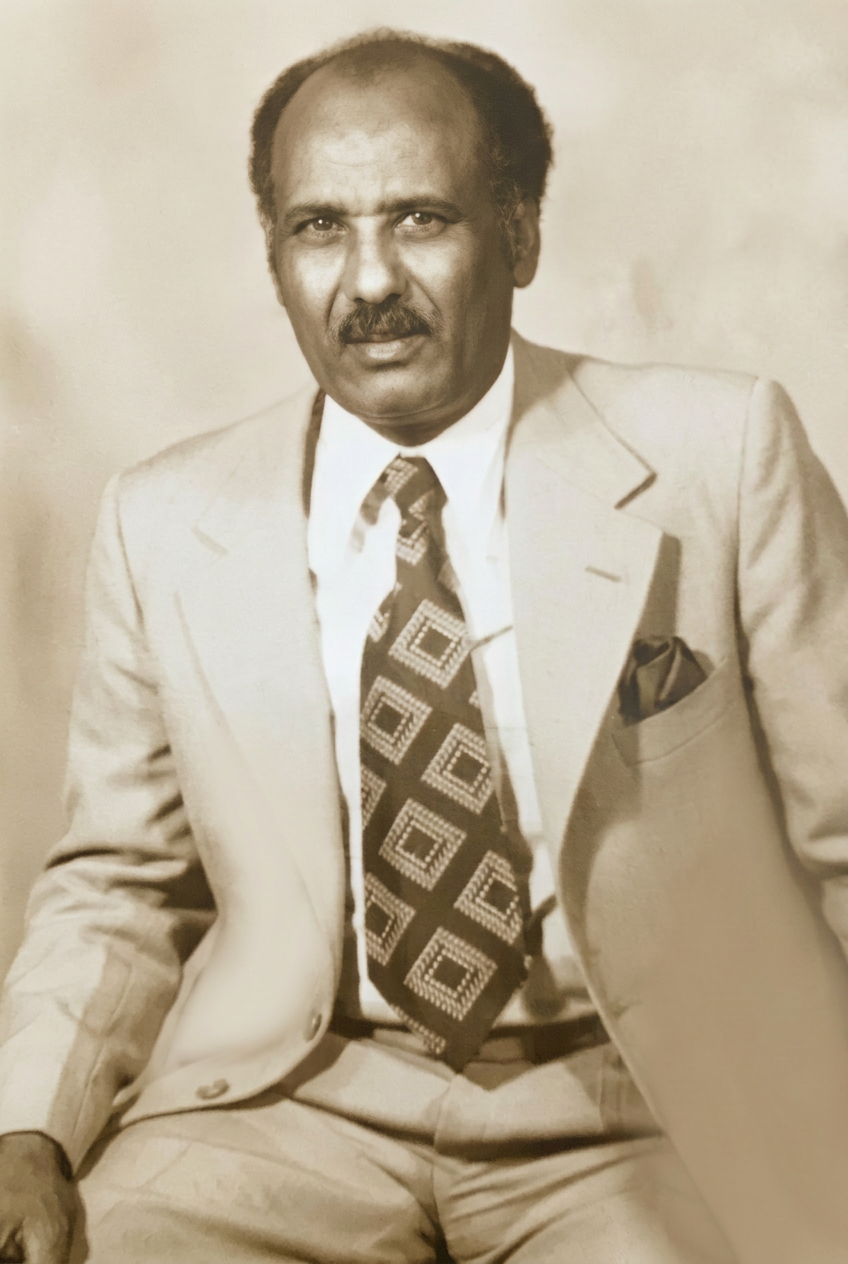
He had looked at what is one of the finest Catholic private colleges in Minnesota and he had made a calculation — the way he always made calculations, quietly, completely, without announcing it to anyone. Employees of the College received reduced tuition for their families. He took the position with that in mind. He knew exactly what he was doing and exactly why.
My late sister Tahirih and I both attended the College of St. Catherine because our father mopped its floors for fifteen years.
A man who had represented Ethiopian Airlines for twenty-one years, who spoke six languages, who had crossed an ocean at sixty-five — chose to become a janitor. Intentionally. Strategically. Because he had looked at a Catholic women's college in St. Paul and decided his daughters would attend it, and then found the most direct path to make that happen.
That is not sacrifice. That is a father being completely, fiercely, unapologetically all in on his children.
The floors of that college were mopped by a man who understood exactly what he was building. He brought the same presence to that work that he had brought to everything else. Without complaint. Because the work was never the point — his daughters were the point. And they were always worth it.
As he was approaching retirement from the College — near the end of those fifteen years — something else happened.
My mother was attending language classes in the evenings at a school in Roseville, Minnesota. My father walked in with her one day. The people there saw him. They spoke with him. And they told him something that must have landed quietly, the way true things do — that his English was advanced. That he had the aptitude for higher education.
I am certain I know where that English came from.
In Asmara, as a young man, he read. Daily. Literature — not newspapers, not manuals, not the minimum required to function. Literature. The kind of reading that builds a mind from the inside. The kind of reading that a boy who found an alphabet at sixteen does when he understands, somewhere in himself, that the alphabet was not the destination. It was the beginning.
He carried that habit across every country, every language, every reinvention. And it showed — in Roseville, Minnesota, decades later — in the quality of his English. In the precision of his thinking. In the way a room full of educators looked at a man and said — you are capable of more than this.
He enrolled. He attended classes. He tested out of others — because a man who had taught himself six languages, who had been educated by Point 4 and Ethiopian Airlines and a civil war and five countries and borrowed books from a British library did not need to sit through what he already knew. He moved through the curriculum the way he moved through everything — directly, without wasting time.
Tahirih
And then, on April 12, 2000, my sister Tahirih was hit by a car while crossing the street.
She passed away on April 19, 2000. On April 20, 2000, she was laid to rest.
Her name was Tahirih Mebrahtu Dawit. Born September 21, 1978, in Asmara, Eritrea. She was twenty-one years old. She was a junior at the College of St. Catherine, majoring in Business Administration. She was the girl who had finished third in her class in Asmara. The same child my father had walked to school every morning, sat with in the corner before the gates opened, said prayers over in the quiet moment before the day began.
She was gone.
Her funeral service was held at Our Lady of Victory Chapel. Approximately 500 people came.
She was a young woman — a junior in college, a daughter of immigrants, a girl from a small family who had crossed six countries to build a life in Minnesota. And 500 people came to say goodbye to her. The chapel was full of people who understood that something irreplaceable had been lost. Something young and promising and full of everything that was still supposed to happen.
We did not go through it alone. That is the truth I want to record here, because the people who held us deserve to be named.
The Eritrean community came — as they always came, with food and presence and the willingness to stay. The Bahá'í community came. The community of the College of St. Catherine came — her classmates, her professors, the people who had watched her move through those halls with the same brightness she had carried since she was third in her class in Asmara. The Lyngblomsten community came. Friends we had made over years of building a life in Minnesota — the ones who had received us and fed us and driven us and sat with us through the ordinary and the unbearable both.
They were there in the hospital during that week. The week she was in the ICU, when we did not yet know what the outcome would be and hope and grief were living in the same room at the same time. They came and sat with us. They did not wait to see which way it would go. They simply came. Through the doors of that hospital and into the hardest waiting of our lives.
When she was gone, they were there for that too.
Five hundred people at Our Lady of Victory Chapel. But the number is not the point. The point is that every one of them had been touched by a girl who had crossed six countries to arrive in Minnesota and had spent twenty-one years making herself indispensable to everyone around her. She had learned that from somewhere. She had learned it from the same man who walked her to school every morning in Asmara and answered every question she ever asked.
She was her father's daughter. The chapel was full because of who she had learned to be.
It hit our community very hard. It hit our small family harder than I have words for. Some of it, I do not think we ever fully recovered from. That is the honest truth about losing someone that way. Suddenly. Without warning. A street, a moment, and then she was gone.
I graduated in May 2000 — a month after we buried her. I was the first person in my family to graduate from college. What could have been the proudest, most joyful moment — the fulfillment of everything my father had worked toward, had mopped floors toward, had stayed behind in a war zone toward — became solemn instead. I carried her with me across that stage. I carried all of them. My father's borrowed books in Asmara. His correspondence courses. His turned-down scholarships. His fifteen years of night shifts in the same buildings where I was now graduating.
The first. And she did not get to see it.
In late 2002 I began working at 3M Company in their Industrial Business Division as a CSR and Inside Sales Representative.
My father was grieving the loss of a daughter. And he went back to his studies.
Mebrahtu Dawit had only one way of moving through the world — forward. Without stopping. To stop would have been to become someone he did not know how to be.
In 2004, as he was preparing to retire from the College of St. Catherine, he graduated.
He was seventy-seven years old. He was the oldest person in that graduating class.
The boy from Geza Kenisha who had found an alphabet from a neighbor at sixteen — who had applied for scholarships as a young man in Asmara and been turned down for lack of a diploma, who had never had the chance to sit in a classroom as a child because he was working, because there was no father, because the world had not made space for him — walked across a stage in Minnesota at seventy-seven and finished what a neighbor's kindness had started sixty years before.
He did it while grieving. He did it while preparing to retire. He did it in Minnesota, an ocean and a lifetime away from Emba Derho.
I do not have the words for what that means to me. I am not sure I ever will.
What I know is this — he never once suggested that it was too late. He had known since he was sixteen years old in Geza Kenisha that learning was always worth doing. The world kept making him prove it in new ways. And he always did.
And on weekends — into his early seventies — he worked a second job as a security guard at Boston Scientific.
Two jobs. A GED earned at seventy-seven. In Minnesota.
He lived to ninety-three and a half years old.
He passed away on May 12, 2021, in St. Paul.
He died during COVID.
We had spent his whole life watching him bring people together — on walks to school, at Sunday morning cafés, in the corners where he said prayers with his daughters before the day began. He was a man made for presence. For showing up. For the gathered community.
We made a different choice for him.
We did not want anyone to risk their health to say goodbye. We held a smaller service — intentionally, deliberately, in the same spirit he had always made decisions — at the Chapel at Lakewood Cemetery in Minneapolis, Minnesota. It was quiet. It was held with love. And it was the right choice, even though right choices can still carry their own grief.
His place of rest was intentionally chosen. He was laid to rest very close to his daughter Tahirih at Lakewood Cemetery. The man who had walked her to school every morning in Asmara, who had stood with her in the corner before the gates opened and said prayers over the day ahead — he was brought to rest beside her. Even in death, he did not leave her side.
He would have understood. He was the one who taught us that the work in front of you is the work in front of you — that you do not wait for perfect conditions, you work with what is there. He had been doing that since he was six years old.
We buried him the way he had lived — without waste. Without performance. With the people who mattered most and the faith that had carried him across every border and reinvention of his ninety-three and a half years.
It was enough. He had always known how to make things enough.
Mebrahtu Dawit from Emba Derho, Eritrea — child laborer, self-taught reader, public health worker, Point 4 employee, Ethiopian Airlines sales representative, survivor of civil war, charter airline representative in Ivory Coast, busboy, parking lot attendant, janitor, high school graduate at seventy-seven, security guard, father, teacher, Sunday morning café companion, man of prayer, keeper of faith, walker of daughters to school — died at ninety-three and a half years old having wasted none of it.
Not one year. Not one job. Not one language. Not one morning.
My sister Tahirih was third in her class that year in Asmara.
She is no longer here.
But she is present in everything I build. The woman who enters this practice and finally feels heard — I think of her. The woman who has been patient long enough and is ready for something that actually works — I think of her. The woman who deserved better and is finally getting it — I think of her every single time.
Belle Vie, Tahirih Mebrahtu Dawit.
My Mother
I want to tell you about my mother too.
She lost her father young — like my father lost his. That loss shaped her in ways I am still understanding.
She went to school as a girl. She was a little overweight. And she had a teacher — someone whose entire purpose was to encourage children to learn — who did not encourage her. Who made fun of her instead. Who made her feel ashamed of the very act of showing up.
She stopped going to school around the 5th or 6th grade.
I have thought about that teacher many times. About what it costs when the person who is supposed to see you chooses not to. About how much potential walks out of a classroom and never comes back because one person with authority decided that a child's shame was acceptable.
My mother went home. And she became something the school never could have taught her to be.
She worked with the Cohen family — a boutique clothing business making garments for the well-to-do in Asmara. Tailored. Elegant. The kind of work that requires a genuine eye for beauty and an instinct for what makes a person feel their best. She had both.
Then she worked at Kagnew Station — the American military installation in Asmara, one of the most significant US bases in Africa during the Cold War. She worked in their salon. Beauty, again. Caring for people. Making them feel seen in the particular way that only happens when someone attends to you with genuine focus and care.
Then she worked at Christine Boutique in Asmara for ten years. Fashion. Style. A decade of helping women present themselves to the world in a way that matched who they were — or perhaps who they were becoming.
My mother worked in beauty and fashion before I was born.
In 1991, she entered a training program that would define the next chapter of her life. It was a joint effort between the International Institute of Minnesota and Lyngblomsten Care Center — a program designed specifically for immigrants with limited English skills, built on the belief that someone did not need to have grown up speaking the language of a country in order to care for its most vulnerable people with excellence and dignity. My mother went through that first cohort. She became a Certified Nursing Assistant.
She stayed for twenty-eight years.
Twenty-eight years. At the same place. Caring for the same kind of people — the elderly, the frail, the ones who needed someone to show up for them with patience and steadiness and genuine attention. She was known there for her kindness. Not as a reputation she cultivated, but as something people simply observed — the way she moved through a room, the way she attended to her patients, the particular quality of care she brought to work that most people would have called routine. It was not routine for her. It was never routine for her. She had spent her whole life making people feel seen and welcomed, from the boutiques of Asmara to the salon at Kagnew Station to the floors of Lyngblomsten. The setting changed. The intention never did.
I think about what it means that my mother spent twenty-eight years caring for people at the end of their lives — bringing the same warmth she had always carried into rooms where people needed it most. She had learned early that the work of making someone feel cared for is not small work. It is among the most serious work a person can do. She took it seriously. Every day. For twenty-eight years.
She had been turned away from school by a teacher who made her feel small. She answered that by spending nearly three decades making sure no one in her care felt anything less than held.
I became a Master Esthetician.
I am still understanding all the ways she lives in what I do.
She was the infrastructure for her family. She helped her mother manage a household with eight other siblings. Both of her maternal grandparents lived in the same home. There were daily visitors — a constant stream of people coming and going, being welcomed and fed and held. My mother was at the center of all of it. Not because anyone asked her to be. Because she understood instinctively that someone had to hold things together so everyone else could be alright.
My father opened doors. My mother made sure everyone felt at home once they walked through them.
I learned clinical precision from a man who taught himself to read.
I learned what it means to make someone feel welcomed — truly, genuinely welcomed — from a woman who a teacher once tried to make feel small.
She never stopped being the most welcoming person in any room she entered.
That teacher was wrong about her. Completely and entirely wrong.
And the practice I built — where every woman who walks through the door is expected and welcomed and treated as though her arrival is the best part of the day — is, in part, my answer to what that teacher did.
Not in anger. In intention.
This is what it looks like when you take someone seriously.
Both my father and my mother made our lives beautiful. That is the only way I know how to say it. They took what they had — which was not much, by any material measure — and they made it enough. More than enough. They made it belle.
That is the thing about people who carry faith and family as infrastructure. They do not need the right circumstances to create beauty. They create it from whatever is in front of them. A borrowed book. A gelato cone. A corner prayer. A cup of cappuccino before Sunday service. A night class in French. An alphabet from a neighbor.
My father did not wait for life to become beautiful. He made it beautiful. Every day. For us.
That is what I am trying to do — in a treatment room in Burke, Virginia — for every woman who walks through the door.
Before I look at your skin, I listen to you. Before I recommend anything, I need to understand who you are — what your skin has been through, what you have tried, what you have stopped hoping for. The DP Skin device measures nineteen things about your skin that the eye cannot see. But the conversation before it measures something no device can — the life your skin has been living inside of.
I did not learn that from a textbook. I learned it on a walk to school in Asmara from a man who always answered his daughters' questions.
Belle Vie
When I was naming the editorial side of this practice — the magazine, the content, the space where clinical knowledge meets the real lives of real women — I needed a name that meant something true.
I chose French.
Belle Vie. The beautiful life.
My father taught himself six languages. He absorbed everything that came his way — the British administration, the American development projects, twenty-one years of Ethiopian Airlines, three years in Nigeria, civil war in Liberia, a charter airline in Ivory Coast, borrowed books from a British library, a neighbor's alphabet in Geza Kenisha. He treated all of it as material for the life he was building.
A life that — from the outside, from a distance, from a history book — might look like a series of circumstances. But from the inside, from the walk to school, from the corner where we said our prayers, from the movie theaters on weekends and the dinner table questions that always got answered — it was the most deliberate, intentional, beautiful life I have ever witnessed.
Belle Vie is his. I just borrowed the name.
This article exists in twenty-two languages — the original English, and twenty-one translations.
Not because it is a marketing strategy. Because my father taught himself six languages from a neighbor's kindness and a borrowed alphabet — and I believe that every woman deserves to be addressed in a way that honors who she is and where she comes from.
English. Somali. Tigrinya. Amharic. Kiswahili. Arabic. Hebrew. Farsi. Turkish. Korean. Mandarin. Hindi. Vietnamese. Tagalog. Spanish. French. German. Dutch. Portuguese. Italian. Russian. Ukrainian.
Twenty-two languages. And nineteen criteria in the skin assessment that every client receives when they walk through the door of this practice.
I do not think that accumulation was planned. But I do not think it is accidental either. Twenty-two ways of saying — I see you. Nineteen ways of measuring what the eye alone cannot. The arithmetic of a practice built on the belief that precision and personhood are not opposites. That clinical care and human dignity are the same thing, approached from different directions.
My father knew that. He knew it before I had words for it. He knew it in six languages and a borrowed alphabet and a corner prayer and a cup of cappuccino before Sunday service.
If you are reading this in any one of these twenty-two languages — this practice was built with you in mind. Before you walked through the door. Before you found the website. Before you knew Amata Lucè existed.
Every clinical decision I make is rooted in what a man from Emba Derho taught me about what it means to take someone seriously. Every language on this website exists because he taught me that no one should have to translate themselves to feel worthy of care.
He found an alphabet in Geza Kenisha and built a life from it.
I found my way back to that story and built a practice from it.
There is one more thing I want to tell you.
On December 6, 2014 — one day after the anniversary of my parents' wedding — I was married. At a place called Central Park in Woodbury, Minnesota. Surrounded by friends and family and all the communities that had carried us through the hardest seasons of our lives — the Eritrean community, the Bahá'í community, the friends we had made over decades of building a life in Minnesota. Every person in that room was part of the chain. Every face was a reminder of what it means to belong somewhere.
My parents had married on December 5, 1975, knowing they might not live long. I married on December 6, 2014, knowing exactly how much it had taken to get there.
And on September 25, 2017, our daughter was born.
September. The same month as her auntie Tahirih.
I do not think that is coincidence. I think that is the kind of thing that happens when a family has been faithful long enough — when the love that was poured into the people who are no longer here finds its way into the ones who are just beginning.
She carries the month. She carries the name forward, in her own way, in her own life, in everything she is still becoming.
Tahirih would have loved her completely.
There are things my father used to say that I carry with me every day.
Learn something and put it away in your pocket.
Be bold, and mighty forces will come to your aid.
And when I was holding on to things that hurt — he would look at me and say: Move on, Gloria. If you keep remembering the past hurts, when you get older, it will turn to a heavy load and it will be too much to carry. Move on.
He said those things the way he did everything — without performance, without drama. Just the quiet conviction of a man who had lived them completely and wanted his daughters to understand that they were true. Not as philosophy. As instruction. As something you could actually use.
He passed on in 2021. And his words have not faded. They have not softened into memory the way some things do. They echo. His admonishments, his encouraging words, his guidance — they are still present. He is still present. He never leaves my mind.
I hope his life encourages all of us. Every person who reads this and recognizes something in him — the persistence, the faith, the absolute refusal to waste a single thing he had been given. We are all walking through a challenging and ever-changing life. None of us are exempt from that. None of us get to coast.
That is something I have come to understand deeply. There is no coasting in this life. We are continuously challenged. And opportunities keep arising — not always in the form we expect, not always in the season we would have chosen — to develop ourselves, to grow, to become more fully who we are meant to be.
My father knew it at sixteen, finding an alphabet in Geza Kenisha.
He knew it at sixty-five, arriving in Minnesota and starting over.
He knew it at seventy-seven, walking across a stage to collect a diploma.
He put everything in his pocket. Every language. Every job. Every setback. Every door that closed and every book he opened instead. He carried it all — not as burden, but as provision. As the accumulated wealth of a life lived without waste.
That is the inheritance he left us.
Learn something and put it away in your pocket.
Be bold, and mighty forces will come to your aid.
I believe him. I have always believed him. And I am still, every day, trying to be worthy of what he showed me was possible.
If you are reading this and you recognize something in him — the self-made person, the one who never waited for permission, the one who was completely, fiercely, unapologetically all in on the people and things he believed in — then you already understand what Amata Lucè is.
And you are welcome here.
He never knew his father.
He lost him so young that not even a memory remained.
And yet — from a neighbor, from an alphabet, from a neighborhood called Geza Kenisha, from night classes and borrowed books and a gelato cone and a corner prayer and fifteen years of mopping floors with the same dignity he brought to everything else — he gave his daughters everything.
He lived ninety-three and a half years.
He did not waste a single one.
Mebrahtu Dawit. October 2, 1927 — May 12, 2021. Emba Derho, Eritrea — St. Paul, Minnesota. Father. Teacher. The man who built everything from nothing.
Maza Habtu. Born in Asmara — laid to rest in July 1990 at Lakewood Cemetery. Auntie. The one who opened the door.
Mebrahtu, Tahirih, and Auntie Maza — they are all buried close to each other.
By Gloria Dawit-Puri — Registered Nurse, Master Esthetician, and the founder of Amata Lucè™ Aesthetics in Burke, Virginia. Belle Vie™ is her digital magazine. amataluce.com