Something changes in the skin around age 40. Not in a single dramatic shift, but gradually. Products that worked stop working. Treatments that produced results produce less. The skin feels less responsive, less resilient, less able to bounce back. This is not imagination. It is biology.
The cells responsible for producing collagen — fibroblasts — slow their output by approximately 1% per year from age 20. By 40 that slowdown is measurable. By 50 it is visible. Most treatments address what this decline looks like. Purasomes address why it is happening.
What Are Exosomes?
Exosomes are extracellular vesicles — tiny membrane-bound structures produced by cells to carry biological information from one cell to another. They are the body's cellular messaging system. They carry growth factors, lipids, proteins, and nucleic acids — the molecular instructions that tell receiving cells how to behave.
When you are young, this cellular communication is robust. Fibroblasts receive instructions to produce collagen and do so readily. Inflammation resolves quickly. Tissue repairs itself.
As we age, this communication degrades. Cells lose the ability to send and receive signals effectively. Fibroblasts slow their collagen production — not because they have lost the ability, but because they are no longer receiving the signals telling them to. Exosomes, applied therapeutically, restore that conversation.
What Makes Purasomes Different?
Purasomes are manufactured by Dermoaroma — an Italian company with 14 registered patents in regenerative aesthetics. Built on the proprietary AMPLEX+ technology, each vial contains a standardized verified concentration of 20 billion highly purified exosomes and 20 of the most clinically potent growth factors identified in regenerative research.
The source matters as much as the concentration. Purasomes are derived from bovine colostrum — harvested within 6 hours of birth from certified organic Holstein cattle on a family-owned farm in Italy. Colostrum is the richest known natural source of growth factors in existence. The formula is 100% natural, non-recombinant, Halal and Kosher certified, and lyophilised to preserve full bioactivity from production to your skin.
This standardization is what separates Purasomes from variable exosome products. Every vial contains the same verified 20 billion exosomes and 20 growth factors. The results are consistent because the formula is consistent.
What Purasomes Do in the Skin
When delivered via microneedling, Purasomes instruct skin cells to increase collagen and elastin production, accelerate cellular turnover, reduce chronic inflammation, improve microcirculation, suppress melanin overproduction, and reactivate dormant hair follicles.
This is cellular reprogramming — not stimulation. The cells receive molecular instructions that redirect their behavior. This is why Purasomes produce results that continue developing for months after each session. The reprogramming does not stop when the treatment ends.
The Three Purasomes Formulations
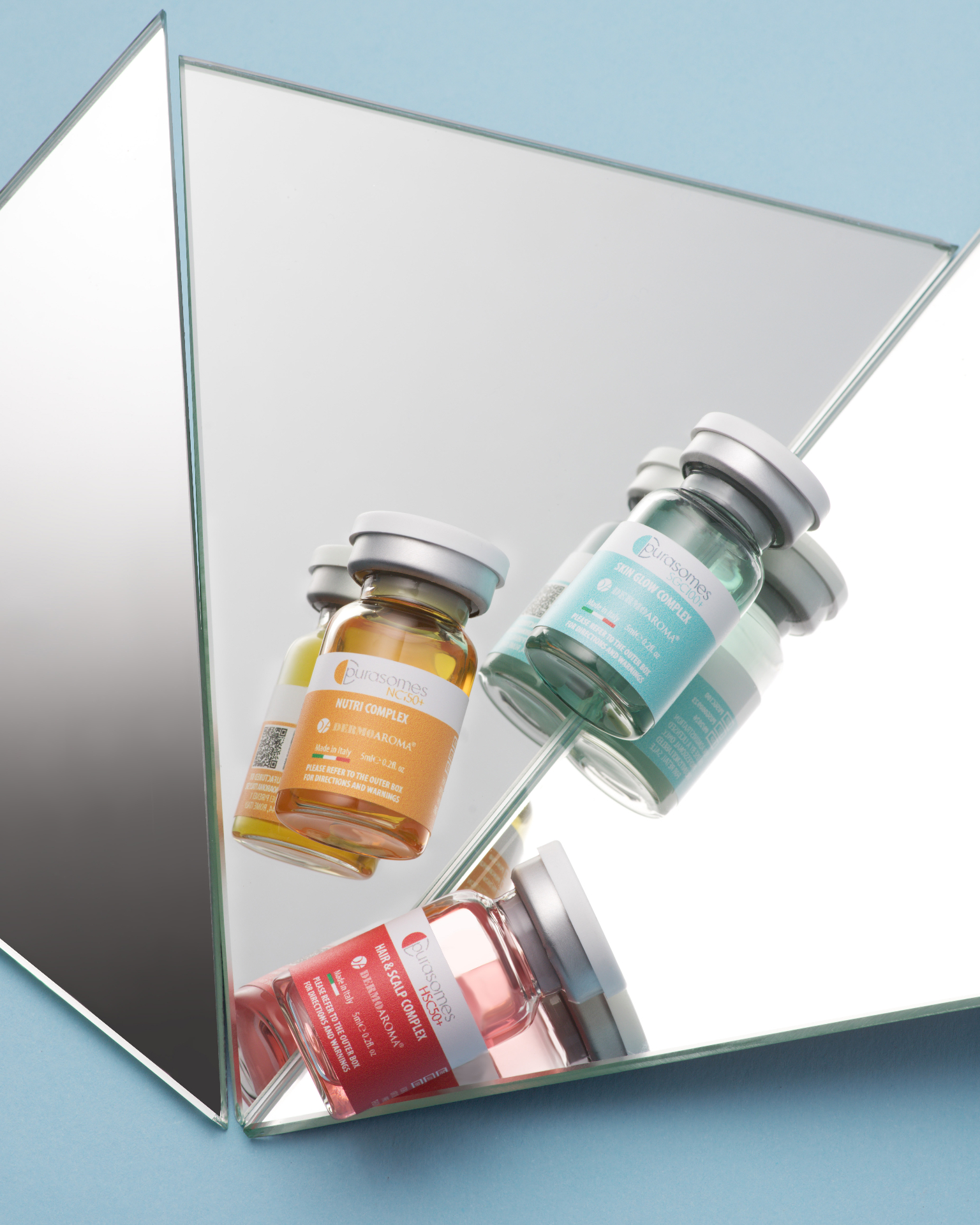
SGC100+ Skin Glow Complex — for pigmentation, melasma, age spots, dull skin, and uneven tone. Manufacturer clinical data shows a significant reduction in melanogenesis (Dermoaroma internal data, up to 46%).
NC150+ Nutri Complex — for loss of firmness, deep lines, skin laxity, structural aging, and collagen depletion. Activates fibroblast formation directly.
HSC50+ Hair and Scalp Complex — for androgenic alopecia, stress-related shedding, postpartum hair loss, and thinning density. Resets the dermal papilla.
Why Microneedling Is the Right Delivery System
Microneedling creates thousands of micro-channels that open direct pathways into the dermis — where fibroblasts, follicles, and collagen reside. Purasomes travel through these channels to the cells where their growth factors do the most work. The micro-injuries simultaneously trigger the skin's wound-healing cascade — so Purasomes arrive at fibroblasts that are already activated and responsive. This is why the combination produces results that neither treatment achieves alone.
What to Expect
A series of 4 to 5 sessions spaced 4 to 6 weeks apart — then we stop. The skin needs several months to complete the collagen maturation the treatment has set in motion. Results continue developing during this rest. Clients frequently notice their skin looks better three months after their last session than one week after.
After Session 1: Improved radiance, more even tone, better hydration.
After Sessions 2–3: Visible texture improvement, pore refinement, early firming.
After Sessions 4–5: Measurable improvement in laxity, reduction in lines, significant pigmentation improvement.
3 months post-series: Full collagen maturation — the most significant structural improvement.
Each session is $800 at Amata Lucè™. Cherry financing available from approximately $200/month.
A Clinical Note from Gloria
I chose Purasomes because they represent something I have looked for throughout my career — a treatment that works with the skin's own biology rather than overriding it. Injectable fillers replace volume artificially. Lasers damage tissue to force a response. Neurotoxins paralyze muscle function. These are not inherently wrong — but they are not regenerative. They do not restore what the skin has lost. They compensate for it.
Purasomes restore. They deliver the biological instructions the skin needs to do what it was always capable of — produce collagen, regulate pigmentation, repair tissue, regrow hair. The results are real — built by the skin itself, from within, over time. That is the standard of care I believe every client deserves.
— Gloria Dawit-Puri, RN + Master Esthetician, Founder Amata Lucè™
Ready to Begin?
Apply for a private assessment at Amata Lucè™ in Burke, Virginia. Gloria will assess your skin, select the right Purasomes formulation, and design a series plan around your specific goals.
This article is written for educational purposes and does not constitute medical advice. Consult a licensed healthcare provider for diagnosis and treatment. Sources available below.
References
On Fibroblast Decline & Collagen Loss With Age
- Varani J, Dame MK, Rittie L, et al. "Decreased Collagen Production in Chronologically Aged Skin: Roles of Age-Dependent Alteration in Fibroblast Function and Defective Mechanical Stimulation." American Journal of Pathology. 2006;168(6):1861–1868. pmc.ncbi.nlm.nih.gov
- Bolke L, et al. "Skin Collagen Through the Lifestages: Importance for Skin Health and Beauty." Plastic and Aesthetic Research. 2021;8:2. oaepublish.com
- Mazur M, et al. "Recent Advances in Dermal Fibroblast Senescence and Skin Aging: Unraveling Mechanisms and Pioneering Therapeutic Strategies." Frontiers in Pharmacology. 2025. frontiersin.org
On Exosomes as Extracellular Vesicles & Cellular Messengers
- Gurunathan S, et al. "Exosomes: A Promising Strategy for Repair, Regeneration and Treatment of Skin Disorders." PMC/NCBI. 2023. pmc.ncbi.nlm.nih.gov
- Fabbrocini G, et al. "Clinical Applications of Exosomes in Cosmetic Dermatology." PMC. 2024. pmc.ncbi.nlm.nih.gov
- Erickson M, et al. "Regenerative Topical Skincare: Stem Cells and Exosomes." PMC. 2024. pmc.ncbi.nlm.nih.gov
- Zhang Y, et al. "Unveiling Exosomes in Combating Skin Aging: Insights into Resources, Mechanisms and Challenges." PMC. 2025. pmc.ncbi.nlm.nih.gov
On Exosome + Extracellular Vesicle Skin Aging Applications
- Kowalczyk M, et al. "Effectiveness of Extracellular Vesicle Application in Skin Aging Treatment and Regeneration: Do We Have Enough Evidence from Clinical Trials?" PMC. 2025. pmc.ncbi.nlm.nih.gov
- Evron E, et al. "Effectiveness of Regenerative Medicine for Skin Lightening and Rejuvenation: A Systematic Review of Extracellular Vesicles and Conditioned Media." Stem Cell Research & Therapy. 2025. link.springer.com
- Garza Veloz I, et al. "Exosomes for Skin Treatment: Therapeutic and Cosmetic Applications." ScienceDirect. 2024. sciencedirect.com
On Bovine Colostrum as a Source of Growth Factors
- Shibata MA, et al. "Revealing the Potency of Growth Factors in Bovine Colostrum." Nutrients. 2024;16(14):2359. pmc.ncbi.nlm.nih.gov
- Gauthier SF, et al. "Growth Factors from Bovine Milk and Colostrum: Composition, Extraction and Biological Activities." Lait/Dairy Journal. 2006;86(2):99–125. lait.dairy-journal.org
- Federici M, et al. "Bovine Colostrum Promotes Growth and Migration of the Human Keratinocyte HaCaT Cell Line." Growth Factors. 2009;27(6):505–516. tandfonline.com
On Microneedling — Mechanism, Dermal Channels & Wound Healing Cascade
- Singh A, Yadav S. "Microneedling: A Means of Collagen Induction Therapy." Journal of Dermatology and Dermatologic Surgery. 2021. journals.lww.com
- Levin J, et al. "Physiological Mechanisms and Therapeutic Applications of Microneedling: A Narrative Review." PMC. 2025. pmc.ncbi.nlm.nih.gov
- Iosifidis C, Goutos I. "Percutaneous Collagen Induction (Microneedling) for the Management of Non-Atrophic Scars: Literature Review." Scars, Burns & Healing. 2019. pmc.ncbi.nlm.nih.gov
- "Microneedling." StatPearls. National Library of Medicine. ncbi.nlm.nih.gov